Tongkat Ali, Horny Goat Weed, Saw Palmetto: What Does the Science Actually Say?
ManForceX, like many men’s wellness supplements, leans on a set of traditional herbal ingredients that have been used for generations in different cultures — Southeast Asian, Chinese, and North American herbal traditions all show up in a single formula. But traditional use and modern clinical evidence are two different things. This article takes each key ingredient in ManForceX individually and looks at what the actual research says, separate from marketing language, including where the evidence is fairly solid and where it’s still preliminary.
Note: This article discusses published research on individual ingredients for educational purposes. It is not a claim that ManForceX itself has been clinically tested, and none of this information should be treated as medical advice. Always consult a healthcare provider before starting a new supplement.
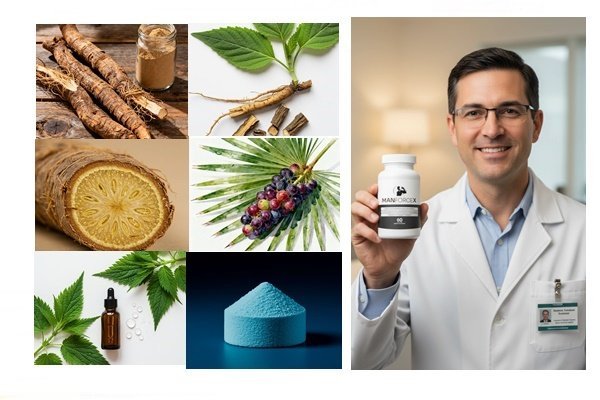
Tongkat Ali (Eurycoma longifolia)
Tongkat Ali is a root extract native to Malaysia and Indonesia, traditionally used as a general tonic for male vitality, stamina, and libido. It’s become one of the more frequently studied botanicals in the men’s health supplement space over the past two decades.
What research has looked at: Several small clinical trials have examined Tongkat Ali’s relationship to testosterone levels in aging or stressed men, cortisol (a stress hormone), and self-reported measures of mood, energy, and libido. Several of these studies found modest increases in testosterone and reductions in cortisol among men with lower baseline hormone levels, along with improvements in self-reported stress and mood scores.
What to keep in mind: Most Tongkat Ali studies have been small (often fewer than 100 participants), and effects tend to be more noticeable in men who started with lower testosterone or higher stress levels rather than in healthy young men with normal hormone levels. Study duration and extract standardization (the concentration of active compounds) also vary significantly between products, which makes it hard to generalize results across different commercial supplements.
Horny Goat Weed (Epimedium)
Horny Goat Weed is a traditional Chinese herb whose name comes from folklore rather than clinical terminology. Its primary active compound is icariin, a flavonoid that has been studied largely in laboratory and animal models for its effects on blood vessel function.
What research has looked at: Most of the available data on icariin’s effects on blood flow and erectile function comes from animal studies and in-vitro (lab) research rather than large human clinical trials. The proposed mechanism involves supporting nitric oxide pathways, which are related to blood vessel relaxation — a similar (though far less potent and differently mechanized) pathway to how some prescription erectile dysfunction medications work.
What to keep in mind: Human clinical data on Horny Goat Weed specifically is limited compared to Tongkat Ali or Saw Palmetto. Its inclusion in supplement formulas is largely based on traditional use and preliminary lab research rather than robust human trials, so claims about its effects should be treated as more speculative than some of the other ingredients on this list.
Saw Palmetto (Serenoa repens)
Saw Palmetto is one of the most extensively studied botanicals in men’s health, primarily in the context of benign prostatic hyperplasia (BPH) — the non-cancerous prostate enlargement that affects a large percentage of aging men.
What research has looked at: Saw Palmetto has been studied in numerous clinical trials for urinary symptoms associated with BPH, with a proposed mechanism involving inhibition of 5-alpha-reductase, the enzyme responsible for converting testosterone into dihydrotestosterone (DHT), a hormone linked to prostate tissue growth. Results across studies have been mixed — some trials show meaningful improvement in urinary symptoms, while larger, well-controlled trials (including a notable NIH-funded study) found effects similar to placebo at standard doses.
What to keep in mind: Saw Palmetto remains one of the most commonly recommended herbal options for mild prostate and urinary symptoms, but the clinical evidence is genuinely mixed rather than uniformly positive — it’s an area of ongoing research rather than settled science.
Nettle Leaf Extract (Urtica dioica)
Nettle Leaf is frequently paired with Saw Palmetto in prostate-support formulas, and has a separate traditional use profile of its own.
What research has looked at: Some studies suggest nettle root/leaf extract may interact with sex hormone-binding globulin (SHBG), a protein that binds to testosterone in the bloodstream and affects how much is “free” and biologically active. There’s also research interest in nettle’s anti-inflammatory properties in the context of urinary tract comfort.
What to keep in mind: Much of the nettle research has been done on the root rather than the leaf specifically, and studies are generally smaller in scale compared to Saw Palmetto research. It’s typically included as a complementary ingredient rather than a primary active compound.
Sarsaparilla Root (Smilax species)
Sarsaparilla has one of the longest histories of traditional use in this list, going back centuries as a general tonic in multiple herbal traditions.
What research has looked at: Modern clinical research on Sarsaparilla specifically for male vitality or hormone support is limited. Most of what’s known comes from traditional use records and a smaller body of research on its anti-inflammatory and antioxidant properties, rather than direct human trials on energy or testosterone.
What to keep in mind: Of all the ingredients discussed here, Sarsaparilla has the least modern clinical backing specific to male vitality claims — its inclusion is grounded far more in traditional herbal use than contemporary research.
Boron (Amino Acid Chelate)
Boron is a trace mineral, and unlike the other ingredients on this list, it’s not a plant extract but a mineral compound.
What research has looked at: A small number of clinical studies have examined boron supplementation’s relationship to free testosterone levels, estradiol, and inflammatory markers (like C-reactive protein), generally over short study periods (a week to a few months) and in fairly small groups. Some studies found modest increases in free testosterone and reductions in estradiol and inflammatory markers.
What to keep in mind: Boron research, while promising, is still an emerging area — sample sizes are small and long-term studies are limited. It’s a mineral the body needs in only trace amounts, and megadosing beyond typical supplemental ranges is not supported by current evidence and could carry risk.
Putting It All Together
Across these six ingredients, the strength of clinical evidence varies considerably:
- Stronger evidence base: Saw Palmetto (though results are mixed), Tongkat Ali (promising but limited to small studies)
- Emerging/preliminary evidence: Boron, Nettle Leaf
- Primarily traditional-use based: Horny Goat Weed (human data limited), Sarsaparilla Root (limited modern research)
This pattern is fairly typical for herbal supplement formulas generally — a blend of ingredients with real (if still developing) clinical research behind them, combined with ingredients whose inclusion rests more on traditional use than modern trials. None of this research has tested ManForceX as a finished, combined product — the studies referenced here were conducted on the individual ingredients, often at specific standardized doses that may or may not match what’s in any particular commercial formula.
Why This Distinction Matters
Understanding the difference between “ingredient research” and “product research” is one of the most important things a consumer can know before buying any supplement. A formula can legitimately include ingredients that have real scientific research behind them, while the finished product itself has not been through the same clinical testing process. This isn’t unique to ManForceX — it’s the reality for the vast majority of dietary supplements on the market, which are regulated differently than pharmaceutical drugs and are not required to prove efficacy before being sold.
Final Thoughts
The ingredients in ManForceX are grounded in a mix of genuine (if still limited) scientific research and long-standing traditional use. Some, like Saw Palmetto and Tongkat Ali, have a meaningful body of clinical study behind them, even if results aren’t uniformly conclusive. Others, like Horny Goat Weed and Sarsaparilla, lean more heavily on traditional herbal use than modern trials. As with any supplement, statements about ManForceX have not been evaluated by the FDA, and it is not intended to diagnose, treat, cure, or prevent any disease. Anyone considering it should look at the actual dosages on the supplement facts panel, understand the difference between ingredient-level and product-level evidence, and talk to a healthcare provider — especially if taking any medication that could interact with these botanicals.